


Continuing from Part 1 of the article, we bring you another 5 amazing tech dive sites in South East Asia.
In this article, we bring you caves, deep reef, wrecks and even shore technical dive sites!
If you had missed out on the first 5 tech dive sties, visit the Part 1 of the article HERE
Talay Song Hong – Lake of Two Rooms
Nakhon sri Thammarat, Thailand
Contributed by: Claus Rasmussen, TDI Instructor

Located around 1 hour drive from Krabi or 4 hours’ drive from Phuket, Talay Song Hong is a small lake found amongst rubber- and palm oil plantations.
By divers, the lake is treated as a cave environment, with lines placed in circuits all around along the walls. Song Hong is a sink hole -so one way to describe it would be as an inverted funnel. Permanent lines in the 6-30m area are located in the Cavern-zone. All deeper lines will at points enter Full overhead environment. That said, dives down to 100m can be executed without entering the “Cave” area and local Free divers utilize the lake for training. Maximum depth registered in the cave so far is 198 m.
The visibility in the shallows is quite dependent on weather conditions and how many people have been diving (or local children playing) there. We generally find that the deeper we get, the better the visibility becomes. Deeper than 50m of depth it is quite common to have visibility exceeding 20m. Even though there in the shallows can be found quite a bit of fish life (including a couple of big catfish), it is the beautiful phreatic rock formations, bacteria colonies and the spellbinding vastness of the lake below the surface, that is the rave of Song Hong.
Suitable training at Talay Song Hong include mostly only technical training levels. It is a favorite of the Cave, CCR and OC Trimix Instructors of Thailand.
Safety Considerations:
Talay song Hong is a pay to access dive site. With the Overhead Environment and extreme depth, caution must be taken and full technical equipment configuration (incl. lights) should be used.
Getting there:
Flights into Phuket or Krabi International Airports -and the car drive to the location. There are no facilities at the site -so all gear, incl. tanks and compressors, are normally brought along by the instructors.
Technical / Cave dive sites (South West Thailand)
Krabi province
Contributed by: Ben Capitaine, TDI SDI Instructor Trainer
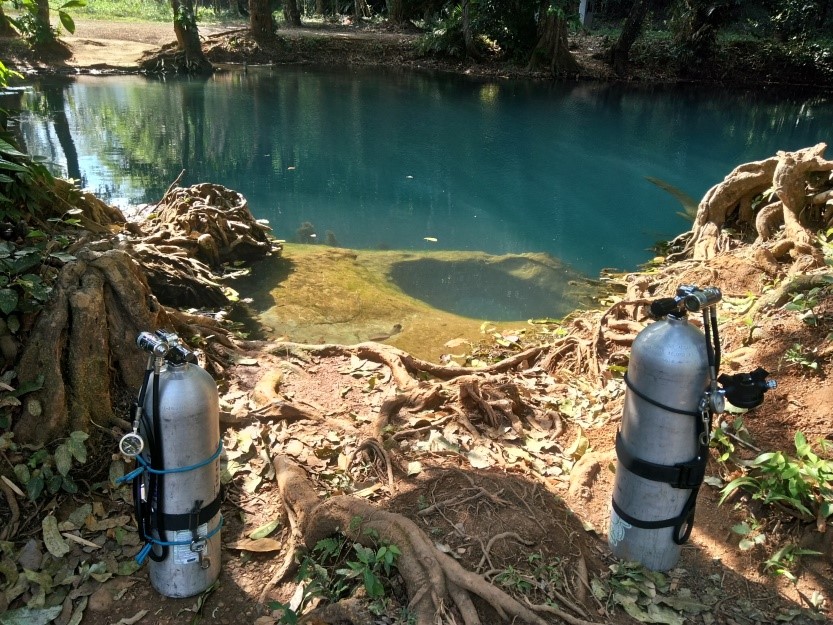
In the beautiful Krabi province lies the little-known jewels of cave diving. With 8 known caves (and more to be rediscovered), it is a playground for the beginner caver to the most advanced explorer with depths ranging from 10 to an astonishing 240m! Discovered between 1999 and 2001 the caves were left alone until resurgence in cave diving by local intrepid instructors in the mid-2000 opened them to the public.
Starting with the Sra Keow cave system: beautiful emerald ponds in the middle of dramatic 150m tall limestone cliffs are a signature of the Krabi province. Many of the caves are interconnected and the caves are named by numbers. Sra Keow 1 and 2 are two small ponds 50m in diameter and separated by a land bridge of equal distance. Those two springs connect at about 70m deep and merge into a straight down shaft to 240m. Other caves provide perfect training ground for entry level cave courses with clearest visibility during the Jan to April period. They are also easily accessible as the truck parking spot is a mere 20m from the water.
A further 30min drive north leads us to two drastically different caves. Klang cave runs through a single limestone tower raising over 100m above a palm tree plantation. This provides a challenging and complex navigation course and a long dry cave takes you to the other side of the mountain via a hard 1h walk & climb. A few hundred meters away lies the Thamsai cave a.k.a. Spitting Spider (from a funny anecdote) which offers the clearest waters with gin like clarity and challenging restrictions only accessible using sidemount setup.
The caves are suitable for all TDI overhead environment courses as well as Extended Range/Trimix for students already full cave trained. All these caves are close to beautiful, local resorts with private rooms and all modern facilities and a short distance to awesome Thai restaurants.
Safety considerations: International hospital with recompression chamber is 30min away by car. Permanent lines are set in every caves.
Getting there: The caves are 3 hours drive from Phuket airport or 8 hours from Bangkok airport. Both these airports are connected by international flights.
Takat Tunang, Gili Islands, Lombok NTB, Indonesia
A deep wall perfect for training and fun diving
Contributed by: Simon Liddiard, TDI Instructor Trainer
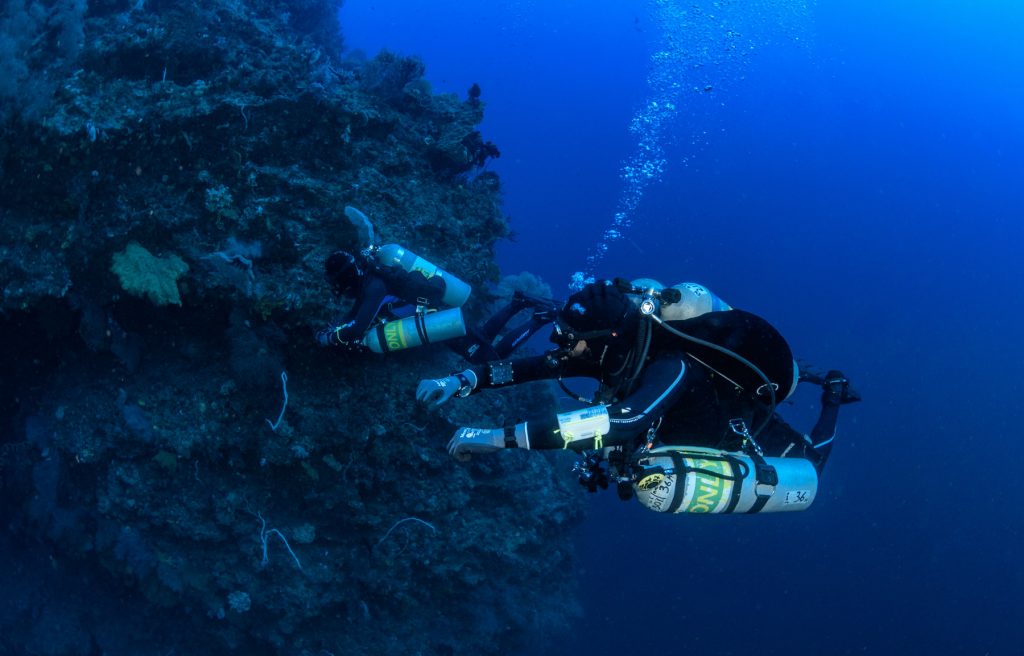
This awe-inspiring wall dive starts at 30 metres and drops to over 1500 metres. From the top of the wall the diver can look down the wall to the abyss below.
The top of the wall is covered in a large variety of corals, colour and massive gorgonian fans and black coral. On the wall there have been encounters with thresher sharks, mola- mola, manta and devil rays. Schools of trevally, fusiliers and snappers are commonly sighted. The slope that leads down to the wall is covered in cabbage and mushroom corals with a diversity of smaller reef fish. Suitable training at Takat Tunang includes Decompression Procedures, Extended Range and Closed Circuit Rebreather courses.
Safety considerations:
Make sure that you have ample redundant buoyancy as the wall descends to 1500 metres and adequate surface support as it is a drift dive along a wall.
Getting there:
The Gilis are a group of islands off the North-West Corner of Lombok NTB. They are easily accessible with direct flights from Singapore to Lombok. There are also fast boats direct to the Gili Islands from Bali. Takat Tunang is easily accessible from the Gili Islands only 30 minutes by boat.
Balikpapan Wrecks
Balikpapan, Borneo, Indonesia
Contributed by: Simon Liddiard, TDI Instructor Trainer

Kuretake Maru (5,175 tons) Tsuruga Maru (6,988 tons) Tatsukami Maru (7,064 tons) Sumanoura Maru (3,519 tons)
Located about an hour of the coast of Balikpapan. These wrecks are suitable for Open Circuit and CCR divers. They are located between 30 – 80 metres in depth so offer a great diving range. The large cargo boats are up to 100 metres in length with ample opportunity for safe wreck penetration. The rooms are vast inside these vessels and you can find multiple stacks of torpedoes, vehicles and ammunition. For any World War II enthusiast this set of wrecks should be on your dive bucket list. Whale sharks have also been spotted on many occasions. Suitable training at the Balikpapan wrecks includes Decompression Procedures, Extended Range and Advanced Wreck courses.
Safety considerations: Meticulous dive planning is important with all wreck diving. There are many diving techniques you need to learn to be able to wreck dive competently. Therefore, training is crucial for safe wreck diving.
Getting there:
Balikpapan has direct flights from Singapore as well as most Indonesian cities. There are currently no dive operators in Balikpapan. All wrecks diving expeditions are arranged by Blue Marlin Dive Indonesia.
The Wakatobi House Reef
Wakatobi Regency, Indonesia
Contributed by: Lorenz Mäder, Wakatobi Resort Founder, TDI SDI Instructor

Located directly in front of Wakatobi Resort, the House Reef begins 2 meters below the surface and drops in a series of walls and steep slopes to depths beyond 60 meters. The site can be accessed day or night by wading in from the beach or directly from the resort’s jetty and it is monitored from 6am to 10pm daily. Taxi boats are also available during daylight hours to drop divers up current, allowing for long drifts along the edge of the wall ending back to the resort. At depths beyond 3 meters down to 45 m divers will find overhangs, gorgonians, tunicates, whips, and sponges in a rainbow of colours. There’s a good chance of spotting larger marine life at deeper depths, including trevallies, wahoo, barracuda, tuna, larger groupers, eagle rays, reef sharks and of course, big green turtles. The warmth and clarity of the water further enhance the enjoyment of extended-duration dives at Wakatobi. CCR divers with a scrubber monitoring device are in for the treat of very long dive times — the current record stands at 6.5 hours! CCR divers are asked to follow the same basic protocols as open-circuit scuba divers – either go with a buddy (also on CCR) or have a CCR instructor or solo diver qualification. Wakatobi’s dive center provides full support for extended range and CCR diving.
Safety considerations:
Currents on the Wakatobi House Reef can range from mild to strong during rising and falling tides. To mitigate the changing currents (there are daily two high and low tides) a DPV saves energy and allows divers to return to the entry point; alternatively, a deployed SMB will inform a taxi boat driver for pickup.
Getting there:
Wakatobi Resort is reached by private direct flights from Bali, which are organized and managed by the Wakatobi team.
