


Scuba diving in Asia means warm waters, crystal clear visibility and huge marine biodiversity. But what about technical diving? In recent years, technical diving has taken off in this region.
Divers carrying more than one tank are becoming more common in the area. Seeing them get ready brings back images of astronauts preparing for a space mission. They are getting ready to dive outside of no-stop limits and deeper than the agency-specified recreational depths – for fun. Dive facilities supporting sidemount, twinsets, helium mixes and rebreather diving can be found almost in all countries in the region.
In this article, we are showcasing some of our favourite technical dive sites in South East Asia. This list is by no means exhaustive, but it’s a great start, and more dive sites are constantly being discovered.
The Drop Off, Tulamben, East Bali, Indonesia
A globally unique shore dive
Contributed by: Marc Crane, TDI SDI Instructor Trainer

The Drop Off, world renowned shore and boat dive located at the south most end of Tulamben Beach. This dive site offers some spectacular scenery as well as the chance to encounter large pelagics, sharks and even the Mola Mola. Classically the Drop Off is a shore dive over a pebble beach into the black sand of the southern end of the bay in Tulamben. The volcanic sand slope runs at approx. 45 degrees angle some 20m of the beach and this sandy slope runs out and down to depths well passed recreational limits and links with the shear wall that is the base of the reef. Here there are multitudes of gorgonian sea fans of different varieties and large ancient barrel and amphora sponges. The wall requires good buoyancy control so as to stick within your planned depth limits as the clear blue water can quickly lead the unaware astray. Along the walls edge current can become confused and daunting so it is critical to stick to the guides briefing. The wall is teeming with life with clown fish protecting their hosts and crustaceans hiding in the cracks. Returning back into the bay gives plenty of protection to complete a safety/deco stop where you can shelter from the current and spend some time looking at amazing macro.
Drop Off is particularly well suited to entry level of tech training as you have sheltered sandy slope dropping into deep water very quickly, ideally suited to practice ascent procedures and team awareness. The wall with the slope and reef is also a fantastic objective for DPV training and diving.
Getting there:
The international airport in Denpasar has global flight connection options. Tulamben is approximately 3 hours away by car.
Kubu Wreck and Reef, North Bali, Indonesia
Perfect for entry level tech divers – and more
Contributed by: Yvonne Press, TDI SDI Instructor Trainer
 Who doesn’t love wreck diving? For many tech divers, this is the reason they got into the sport. The Boga wreck in Kubu, a short drive north of Amed and Tulamben, is an excellent wreck dive for entry level tech divers. The wreck was sunk deliberately, and has since become home to plenty of coral, schooling batfish and more. You will find recreational divers here, but as a tech diver you have time to explore it all.
The deepest part of the wreck is the propeller located in 36-38 metres, depending on the tide. There are plenty of entry points into the inside of the wreck. It’s tight enough to hone your buoyancy skills without having serious restrictions, and it’s dark enough to practice light communications whilst still having natural light sources around.
For deeper trimix or rebreather dives, the wreck is an excellent waypoint. The volcanic terrain you see above water continues underwater with some breathtaking topography that makes for exciting dives. The deeper you go, the better your chances of encounters with schooling barracudas, sharks and perhaps even a mola. If you’re lucky, you get breathtaking topography, pelagic species encounters, and a wreck dive all in one.
Safety considerations: It’s a classic north Bali entry over rolling rocks. Easier to do at high tide. The porters in Kubu are also extremely helpful. If you need a lot of tanks, consider bringing a helper to carry them in and out of the water.
Getting there:
Tech diving shops in Amed and Tulamben support trips to the wreck and the reef areas around it. The area is a 2.5 hour drive from Bali airport.
Turtle Tomb Cave, Sipadan Island , Sabah , East Malaysia
Final resting place of turtles
Contributed by Jason Lim, TDI SDI Instructor Trainer

Sipadan Turtle Cave is located on the side of a large limestone at a depth of about 20 meters. A large sign near the entrance warns inexperienced divers not to enter without the appropriate equipment or experience.
The main cave is divided into 2 chambers with corridors around 10 meters in height. The floor of the cave’s chambers is filled with fine white sand, upon which are several skeletons remains of long dead turtles.
Entering the cave, we can see that both Chambers & Corridors have their own unique formation. The first chamber, also known as the dolphin cave, is very similar to a sinking hole of 25meters depth. From the bottom, you will find another small passage into the so-called chimney natural formation, where the small penetration can lead us back to the cave.
The second chamber, the turtle tomb, is a small tunnel with a horizontal entrance. Before reaching the main chamber of the turtle tomb, we will go through a tunnel which is around 20meters long. As this area is deprived of sunlight, the turtles were believed to have accidently entered the chamber and were not able to find their way out.
As the cave does not have any permanent fixed line to prevent non-certified or inexperienced diver from entering. Do bring along your personal primary reel. You may also consider few jump lines as you enter the main chamber where you will find some interesting small passages with small stalactites.
Getting there:
Most visitors fly to Tawau airport from either Kuala Lumpur or Kota Kinabalu, continue by minivan or taxi to the port town of Semporna. Since 2002, it is no longer possible to stay directly on Sipadan Island.
Linda’s Reef, Gili Trawangan, Lombok, Indonesia
A lush deep wall full of sharks, rays and schools of fish
Contributed by Philip Chrisoff, TDI SDI Instructor Trainer
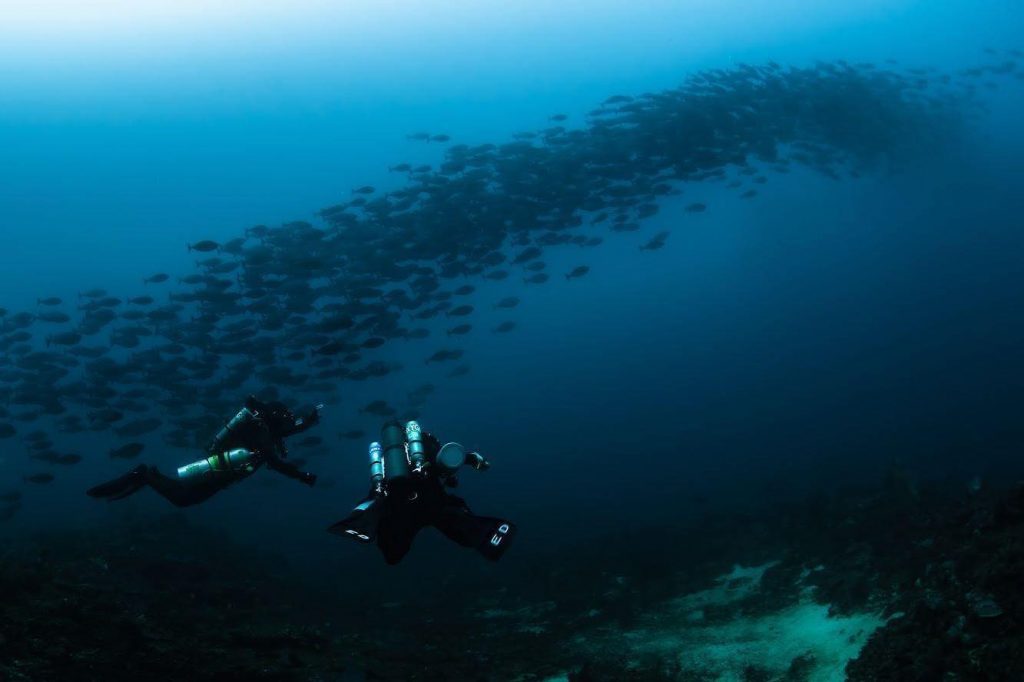
This newly discover dive site was found in November of 2019 only 4km north east of Gili Trawangan. The reef which starts at 45m leads to a long section of deep walls that drop to 150m+ with beautiful topography. Stunning corals grow on the overhangs and cracks in the wall and the abundance of fish, sharks and rays is unrivalled in the area. All year round the site is covered in a huge school of surgeon fish with hunting Giant Trevallies and Dogtooth Tunas. In the late summer and fall months Grey Reef sharks and Oceanic Black Tip sharks are seen regularly and, on a few occasions, small schools of Hammerheads have been spotted in addition to sightings of Thresher sharks and Mola Molas. New deco divers can enjoy the top of the reef where most of the actions is happening while more experienced trimix diver can explore the deeper sections of the wall. The site is best navigated on underwater scooter and for the shark encounters CCR is highly recommended.
Suitable training: this dive site is an excellent spot for newly certified Advanced Nitrox and Decompression Procedures divers to fun dive or continue their education with extended range. It is also great for Helitrox CCR divers and offer training opportunities all the way to advanced Trimix.
Safety considerations: Currents can be strong but visibility is usually great. Good descent performance is critical to reach the best part of the dive site and drift dive experience is recommended.
Getting there:
Gili Trawangan can be reached directly from Bali or Lombok international airports. Once on Guli Trawangan the dive site is only a short 10minute boat ride away.
The “Unicorn” Wreck, Koh Tao, Thailand
Koh Tao’s local Wreck for Tech divers
Contributed by: Andy Campbell, TDI SDI Instructor Trainer
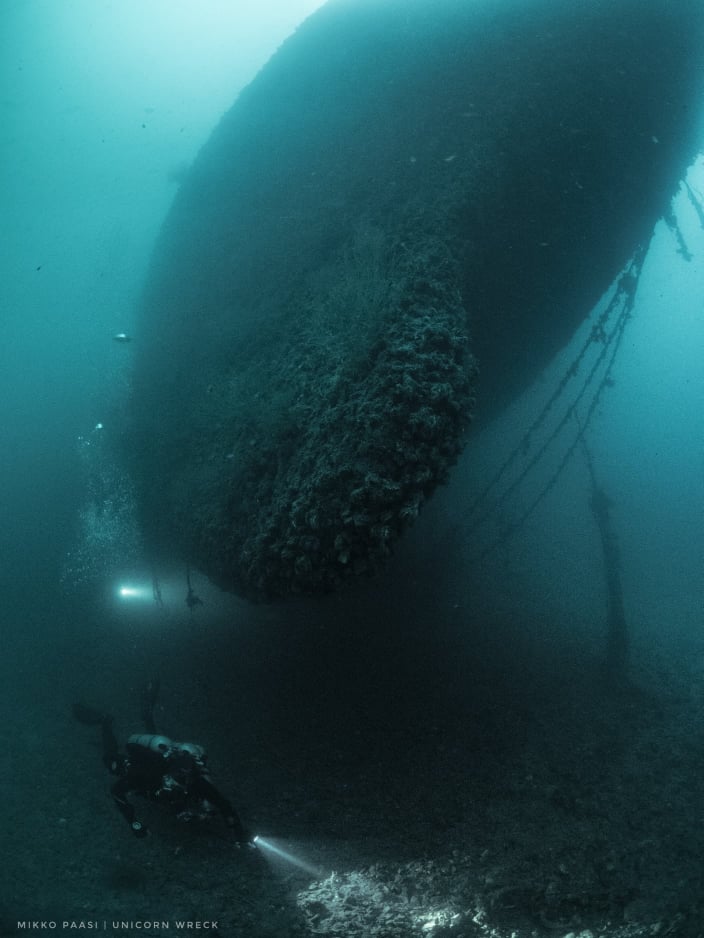
The Hishidaiya Maru AKA as the Unicorn wreck dive off Koh Tao
When the Hishidaiya Maru originally sank in 1989, Koh Tao locals said that the ship just pulled up off shore around 3 miles North of Koh Tao and over the next couple of hours slowly sank. Insurance Fraud was immediately suspected and divers soon confirmed the holds did not contain the high quality Tuna claimed for so with no casualties Koh Tao gained a wreck that has severed her well for over 30 years.
The decent toward the wreck is normally in good viz but this can soon drop so a good shot line is required to find the sometimes elusive “Unicorn”. The Hishidaiya Maru is is a 60m long steel freighter lying stern down on the bottom at a depth of 50m, listing slightly to its port side with the main deck is at 45meters. The bow area is several meters above the seabed, allowing divers to swim under this area of the hull and a steel mast rises to 34m and is usually the first and last thing divers see on a dive.
Suitable training at Unicorn includes the final stages of Advanced Nitrox and Decompression courses as well as Helitrox and Trimix Diver.
Safety Considerations
Being a low visibility dive site that can experience currents, the use of lines for descent and navigation are normally required. The wreck has large nets in places and penetration is not recommended with a total silt-out likely even with extreme care.
Getting there:
Getting to Koh Tao is very easy from Thailand’s main transport hubs with the easiest option a flight to Koh Samui and a ferry to Koh Tao.
